Awards

APS Awards and Nominations

The Applied Probability Society of INFORMS offers three prizes each year. One prize is the best student paper prize (started in 2017). One prize alternates between the Best Publication in Applied Probability Award (in odd numbered years) and the Erlang Prize for Early Career Applied Probabilists (in even numbered years). One prize is the David Blackwell Prize (started in 2023). The list of current members of the Prize Committee can be found here.


Latest Calls for Nominations: 


Best Student Paper Prize

      • Award Information
      • Recent Winner: Shengbo Wang (Stanford University)
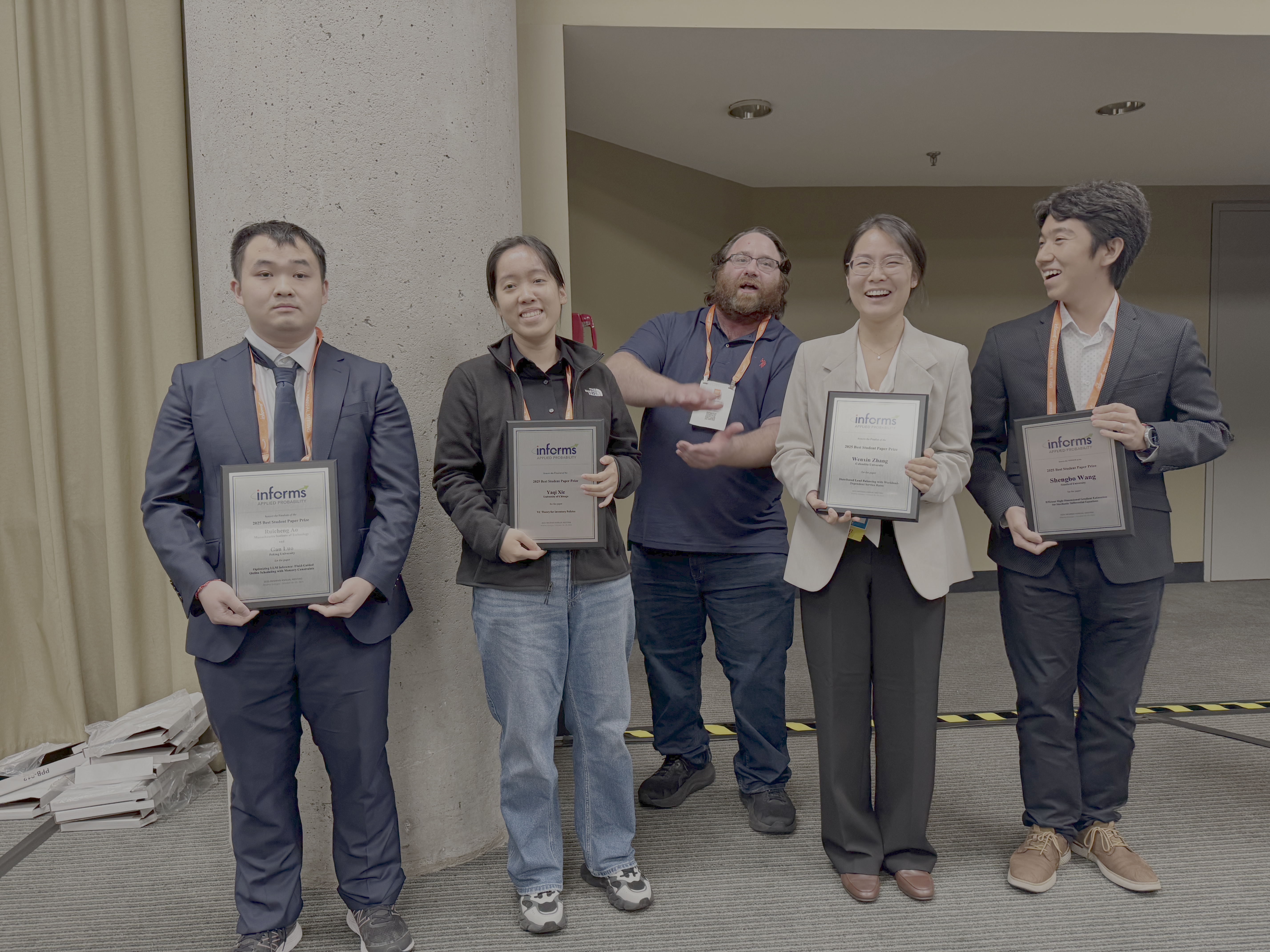
      • Recent Finalists: Ruicheng Ao (MIT), Yaqi Xie (University of Chicago), Wenxin Zhang (Columbia University)
      • Past Award Winners

2025 APS Best Student Paper Finalists


Best Publication in Applied Probability Award
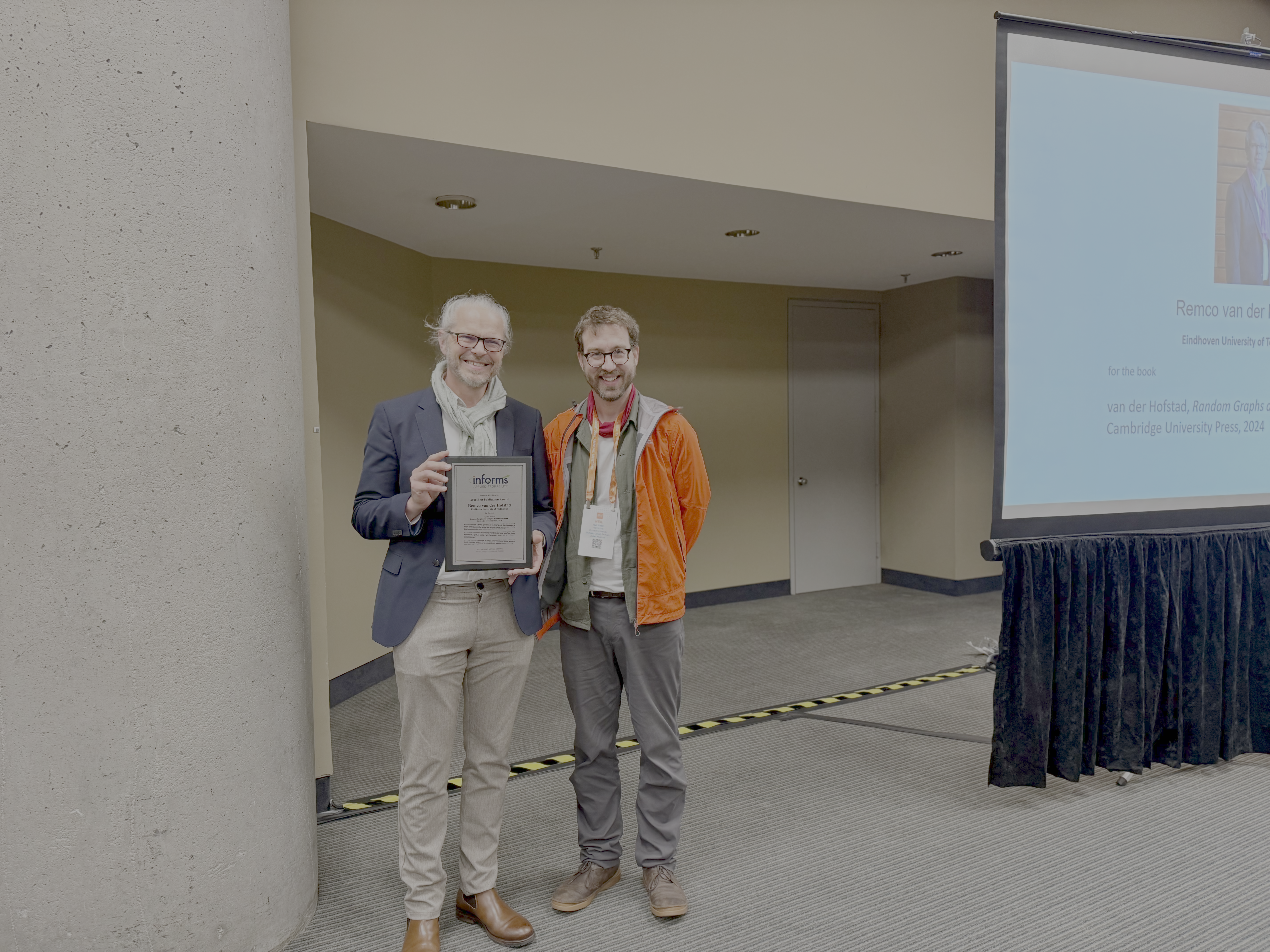


2025 APS Best Publication Winner


Erlang Prize for Early Career Applied Probabilists


Daniel Russo (2024 APS Erlang Prize Winner)


    Blackwell Prize
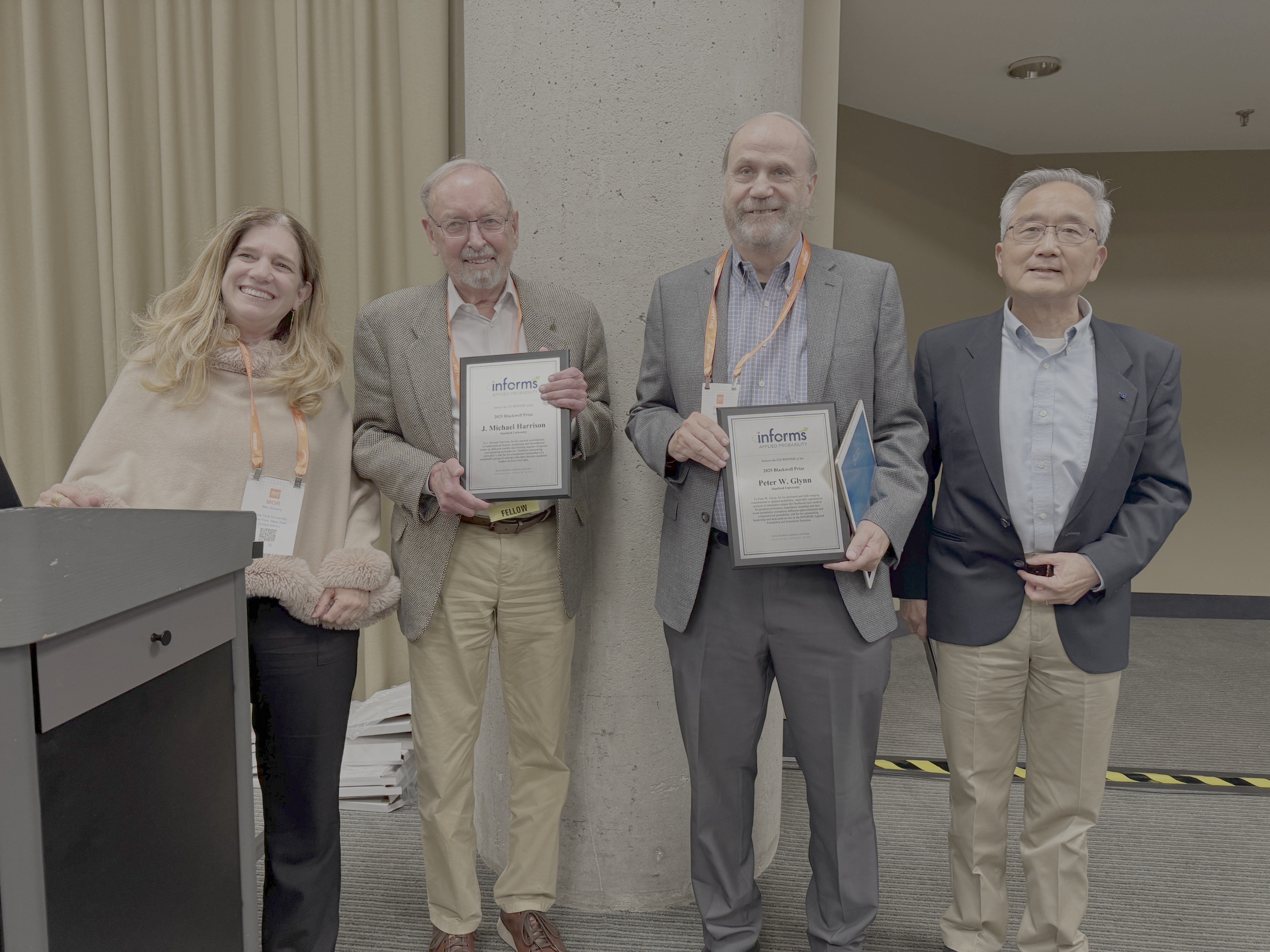


    2025 Blackwell Prize Winners
    (Frank P. Kelly could not be in the picture)

    Peter Glynn's citation:

    Peter W. Glynn, the Thomas W. Ford Professor in Engineering at Stanford University, is a co-winner of the 2025 Blackwell Prize. This award of the INFORMS Applied Probability Society (APS) recognizes fundamental and sustained career contributions in the field of applied probability.

    Peter Glynn’s work lies at the foundation of stochastic simulation, which he helped elevate from a loose amalgam of computational ideas when first he began working in the area to a rigorous discipline built on the foundation of probability theory. He is especially known, in this subject, for his work on regenerative simulation, the development of likelihood-ratio gradient estimation, importance sampling and rare-event simulation and multi-level Monte Carlo. He is also deeply respected for his work on computational probability, queueing theory, statistical inference for stochastic processes, and stochastic modeling. He has worked on problems arising in machine learning, exposing glaring problems with the application of widespread notions like regret minimization in dynamic learning. His research has consistently demonstrated the exquisite interplay between theoretical depth and practical applicability that characterizes top-shelf work in applied probability. His work has profoundly influenced, and continues to influence, wide-ranging developments in the field. In these and other endeavors, he has advised over 50 PhD students, many of whom have also become academic and research leaders in the field.

    Glynn’s professional service contributions are equally impressive. For example, he was the Chair of INFORMS/APS from 2004-2006, and the founding Editor-in-Chief of Stochastic Systems, the flagship journal of INFORMS/APS. He has also served as the Editor-in-Chief of the Journal of Applied Probability and Advances in Applied Probability (2016-2018), and as co-editor of the Journal of Computational Finance (1997-2001). 


    J. Michael Harrison's citation:

    J. Michael Harrison, the Adams Distinguished Professor of Management, Emeritus, at Stanford University Graduate School of Business, is a co-winner of the 2025 Blackwell Prize. This award of the INFORMS Applied Probability Society (APS) recognizes fundamental and sustained career contributions in the field of applied probability.

    Mike Harrison has made seminal contributions to mathematical finance. His breakthrough papers (co-authored with Kreps in 1979 and with Pliska in 1981) revolutionized mathematical finance in developing the mathematical foundations of option theory, and (quoting from one nomination letter) “showing that the 1973 Black-Scholes-Merton Nobel Prize-winning approach to modeling option prices was at the leading edge of a far bigger family of tractable problems." Harrison has also been a leader in developing and advancing the use of Brownian models for the analysis and control of a broad class of networks that he calls “stochastic processing networks”. Especially, in characterizing the limiting regimes of queues and queueing networks and facilitating their computation and approximation, he and his co-authors have developed pioneering concepts and fundamental tools such as reflected Brownian motion (RBM) in an orthant, basic adjoint relationship (BAR), and state-space collapse. 

    Throughout his long career, Harrison has advised or mentored a remarkable group of scholars who have become academic leaders in their own right. The list is “perhaps unparalleled in the breadth and depth of his mentoring activities”, quoting from another nomination letter, including multiple members of NAE (National Academy of Engineering) and NAS (National Academy of Science), numerous winners of top INFORMS awards (such as von Neumann Prize and Lanchester Prize), and several deans of leading business schools (Cambridge, Chicago and Columbia), and provost (Johns Hopkins) and president (Tufts). 


    Frank Kelly's citation:

    Frank P. Kelly, Emeritus Professor of the Mathematics of Systems at the University of Cambridge, is a co-winner of the 2025 Blackwell Prize. This award of the INFORMS Applied Probability Society (APS) recognizes fundamental and sustained career contributions in the field of applied probability.

    Frank Kelly has made foundational contributions to the theory of queueing and stochastic networks. He developed the notion of quasi-reversibility as a fundamental property that characterizes so-called product-form networks, a broad class of queueing networks that exhibit attractive structural properties, facilitating exact analyses and computations. Kelly has also been instrumental in extending Erlang’s classical loss-network model to the principled design and analysis of contemporary telecommunication systems and protocols. He pioneered the concept and the underlying theory of proportional fairness and network utility maximization, both of which have become instrumental in designing optimal resource allocation schemes and protocols in the Internet (e.g., TCP/IP) and data center networks.

    Kelly’s scientific contributions have won wide recognition across the UK, EU and the US by multiple professional societies in communications/computing (IEEE Alexander Graham Bell Medal, IEEE Kobayashi Award, SIGMETRICS Achievement Award), in mathematics and statistics (Guy Medal of the Royal Statistical Society, Naylor Prize of the London Mathematical Society, David Crighton Medal of IMA and LMS), as well as in operations research (Beale Medal of the Operational Research Society, EURO Gold Medal, INFORMS von Neumann Prize and Lanchester Prize).