Dear Colleagues and Friends,
As we open the door to a new academic year, I would like to give a quick update on the state and health of Management Science. Over the past eight months, we have seen a high volume of submissions, indicating that 2023 will be the third year in a row that submissions will exceed 4000 papers. Even with this high volume, Management Science continues to maintain excellent turnaround times. Indeed, thanks to the efforts of the entire management science community, the average time to first decision for regular papers is about 70 days, and for Fast Track papers, it is about 30 days.
Importantly, Management Science has been and continues to be one of the most prestigious journals in the field. As Tinglong Dai and I pointed out in a July blog, Clarivate's Impact Factor calculations are in transition, so it is hard to decipher important insights and trends about INFORMS journals. However, improvements can be seen by looking at the 2023 Google Scholar Metrics. Indeed, Management Science's h5-index has increased from 109 last year to 114 this year, and the h5-median has increased from 165 to 173. These two metrics count citations for papers published in the last five complete calendar years. As you can see in the figure below, Management Science continues to rank very high compared to the rest of the 24 journals used for the UTD (University of Texas at Dallas) Top 100 Business School Research Rankings.
Finally, you may recall that in my editorial on January 2020, see From the Editor (Management Science, 2020 Vol. 66, No. 1, January 2020, pp. 1–4), the editorial board initiated the following challenge to the management science community:
"The editorial board would like to publish a paper, likely a Fast Track paper, that reports replicability of laboratory experiments published by Management Science. This was done in economics (Camerer et al. 2016), and in social science (Camerer et al. 2018), and it is time to do the same for Management Science papers."
A team of eight academics with significant experience in behavioral operations collaborated on this replicability challenge. The team includes members from five institutes with established labs, which allowed us to conduct each replication at multiple sites. The faculty involved include Andrew Davis, Cornell University; Blair Flicker, University of South Carolina; Kyle Hyndman and Elena Katok, University of Texas at Dallas; Samantha Keppler and Stephen Leider, University of Michigan; and Xiaoyang Long and Jordan Tong, University of Wisconsin.
The team collected survey results from the community, asking participants to vote for the papers they would like to see replicated. The papers were in the following five areas: inventory management, supply chain contracts, queueing, forecasting, and sourcing. The team selected two papers with the highest number of votes from each category, for a total of 10 papers. Each paper was replicated at two different sites.
I am pleased to report that the paper describing the project, "A Replication Study of Operations Management Experiments in Management Science," has been accepted by Management Science and will be published in the September 2023 issue of the journal. I asked two behavioral economists familiar with recent replication studies in the social sciences, Colin F. Camerer (California Institute of Technology) and Yan Chen (University of Michigan), to reflect on the significance and impact of the paper for our community in general and for behavioral research in particular. Their perspectives can be found on the journal's blog page.
I wish you all a productive new academic year!
David Simchi-Levi
Editor-in-Chief, Management Science
E-mail: mseic@mit.edu
Figure: Google Scholar Metric for Journals on the UTD-List
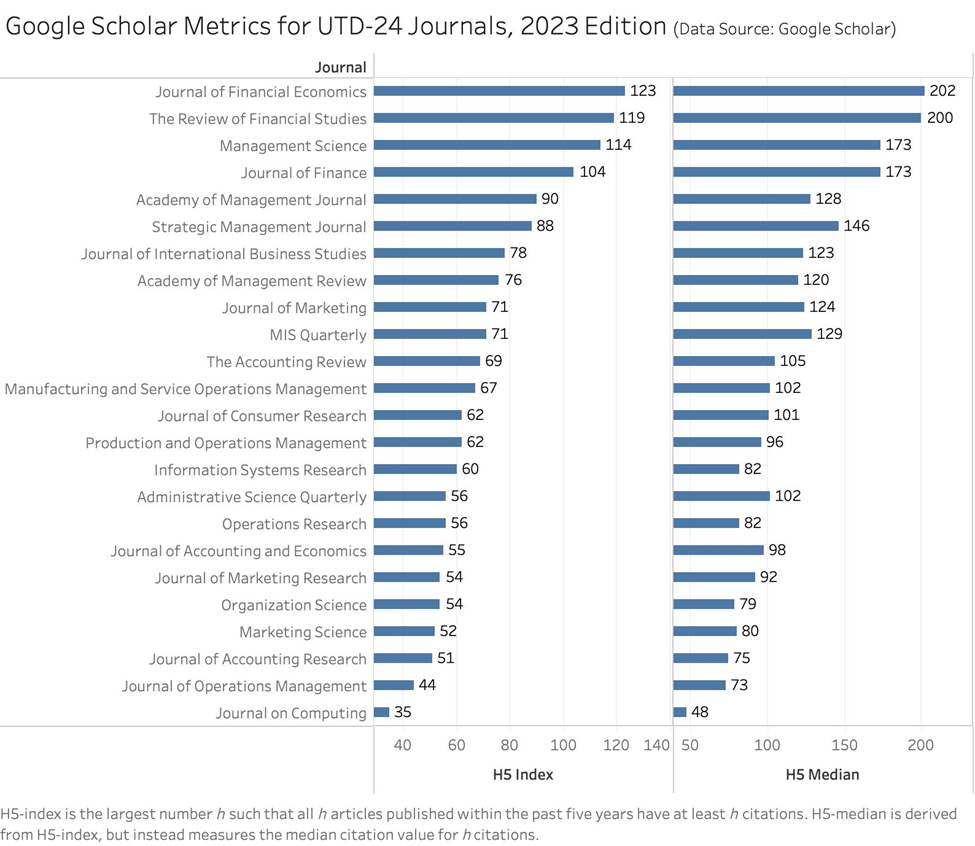
*Data sources: Google Scholar Metrics, updated in July 2023 (https://scholar.google.com/citations?view_op=top_venues). The visualization was produced by Tinglong Dai, Johns Hopkins University.
------------------------------
David Simchi-Levi
Professor of Engineering Systems
Massachusetts Institute of Technology
Cambridge MA
------------------------------